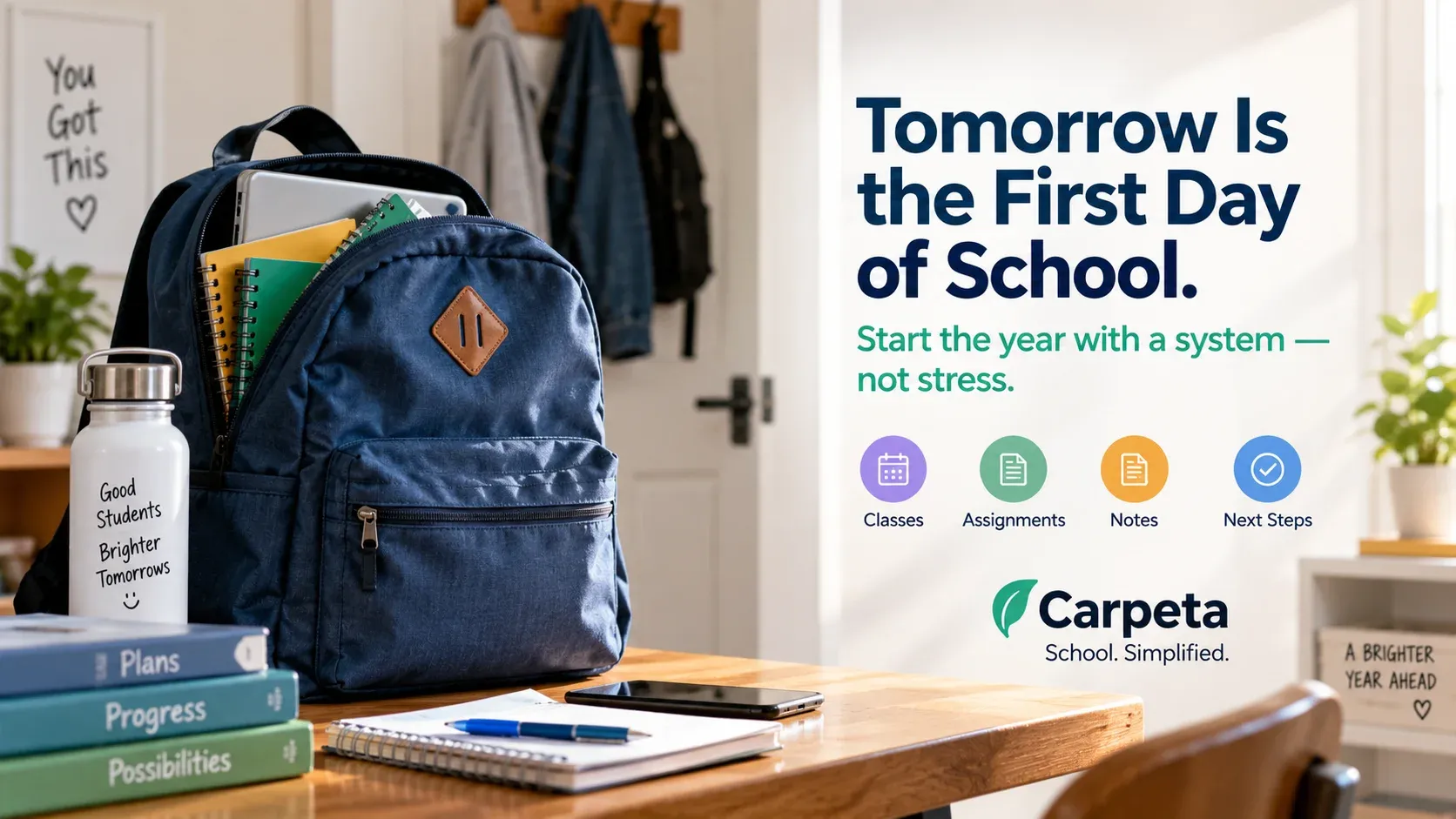
Tomorrow Is the First Day of School. You Don’t Need to Have It All Figured Out.
Tomorrow morning, the alarm goes off and summer officially gives way to another school year. Backpacks will be zipped, lunches packed, schedules checked one last time, and thousands of students will walk through the doors of their schools wondering what the next ten months are going to look like.
For students, the first day brings a strange combination of excitement and uncertainty. There are new teachers to meet, new classes to find, different expectations to understand and, for some students, an entirely new school to navigate. Parents experience their own version of that uncertainty. Alongside the usual first-day preparations is often a quieter question: How do we make this school year go a little more smoothly than the last one?
The answer doesn’t require having the entire school year figured out tonight. In fact, one of the best things about the first day of school is that almost everyone gets to start again.
Start the year before it gets busy
The first few days of school are usually relatively manageable. There may be forms to bring home and course outlines to read, but the assignments haven’t started piling up yet. Tests are still somewhere in the future, major projects haven’t reached their deadlines, and the backpack hasn’t accumulated three months’ worth of papers.
That makes September the perfect time to establish a few simple habits.
When a teacher gives an assignment, put it somewhere you know you’ll find it again. When a test or presentation date is announced, add it to your calendar instead of relying on yourself to remember it. Keep the notes from each course together, and when a teacher assigns something that feels too large to tackle in one sitting, break it down into smaller steps that can be completed one at a time.
None of those ideas are particularly complicated. The challenge is making them part of the normal school day before things become busy.
School rarely becomes overwhelming overnight
Organization usually doesn’t fall apart because of one catastrophic mistake. It happens gradually. An assignment doesn’t get written down because you’ll “remember it later.” A permission form stays in the backpack. Notes from one class get mixed in with another. A project that isn’t due for three weeks doesn’t seem important until, suddenly, it’s due Friday.
By the time October or November arrives, a student who felt completely in control during the first week of school can feel like they’re constantly trying to catch up.
That’s why the beginning of September matters. It’s much easier to build an organizational system when there are only a handful of things to organize than it is to create one after assignments, tests, projects, extracurricular activities and everything else have already started competing for attention.
Students shouldn’t have to remember everything
One of the most useful habits a student can develop is learning not to use their memory as their school planner. There is already enough to think about during a normal school day without also trying to mentally track every assignment, deadline, test, note and responsibility.
Instead, students need somewhere they trust to keep that information. The particular system matters less than the habit of actually using it. If an assignment is always recorded when it is given and upcoming tests are always added to the same calendar, students no longer have to spend their evenings wondering whether there was something they were supposed to remember.
That changes the question from “What am I forgetting?” to “What do I need to do next?”
It’s a small change, but it can make school feel considerably more manageable.
Parents don’t need to become school managers
The beginning of another school year can also bring back a familiar routine for parents: Do you have homework? When is that assignment due? Did you study for your test? Where is the form I need to sign?
Those questions usually come from a good place. Parents are trying to prevent their children from falling behind. The problem is that when parents become the system for keeping track of school, students have less opportunity to develop that system for themselves.
The goal isn’t to stop helping. It’s to gradually change what that help looks like.
Instead of trying to remember every deadline for them, help your child establish somewhere to record those deadlines. Instead of repeatedly asking whether an assignment has been completed, help them build a routine for checking what needs to be done. When a large project arrives, help them think through the smaller steps involved rather than waiting until the night before it’s due.
There will still be forgotten assignments. There will probably still be a project discovered later than anyone would like. Building independence doesn’t happen because a student downloaded an app or bought a planner; it happens through repetition. The important thing is that the system increasingly belongs to the student rather than the parent.
Tomorrow is only Day One
There can be a lot of pressure around the beginning of a new school year. Students see perfectly organized study spaces online, parents buy planners and calendars, and everyone starts September determined that this year is going to be different.
It doesn’t have to be that complicated.
Tomorrow, start with the first class. Keep the notes from that class together. Record the important dates the teacher gives you. When the first assignment arrives, write it down. When something needs several days of work, decide what the first step is.
Then do the same thing for the next class.
A successful school year isn’t built during one perfectly organized evening before the first day. It’s built gradually, through hundreds of small decisions made over the months ahead. Starting with a simple system now makes those decisions much easier when school inevitably gets busier.
So tonight, pack the backpack, set the alarm and enjoy what’s left of summer. You don’t need to have the next ten months figured out.
You just need somewhere to start.
Have a great first day.
School. Simplified.
Carpeta brings classes, notes, assignments, schedules and next steps together in one place, giving students a single place to answer two important questions: What do I need to do, and how do I accomplish it?