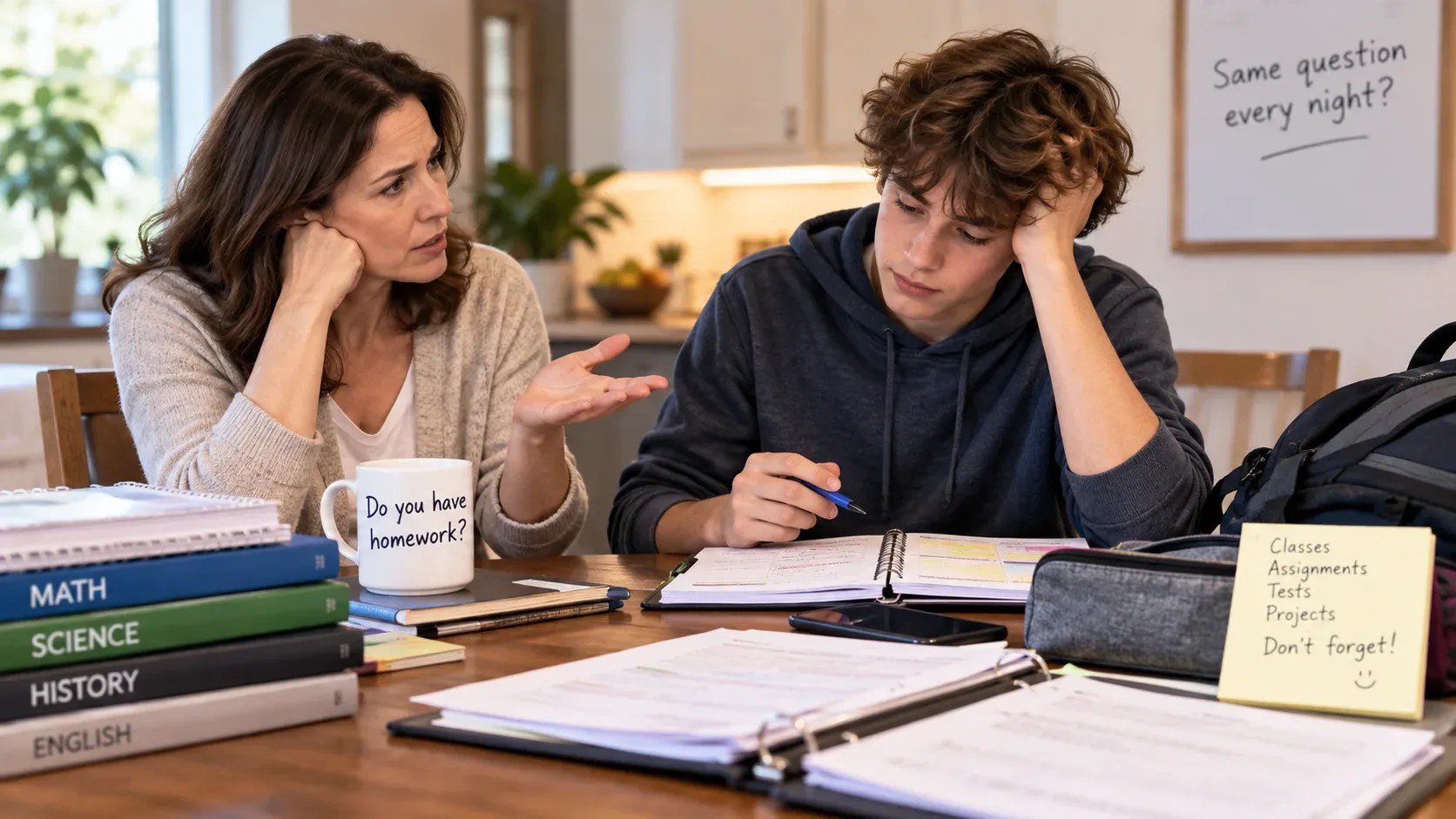
How Do I Stop Constantly Asking, “Do You Have Homework?”
“Do you have any homework tonight?”
“No.”
“Are you sure?”
“Yes.”
“What about math?”
“Oh. Yeah. I have math.”
“And didn’t you say something about a science assignment?”
“Oh yeah. That too.”
If this conversation sounds familiar, you are certainly not alone. For many parents, keeping track of their child’s schoolwork gradually becomes a second job. You ask about homework, remind them about tomorrow’s test, check whether the permission form made it into their backpack, and try to remember the project they casually mentioned sometime last week.
Eventually, it can feel as though the only thing standing between your child and a missed assignment is you. That leaves many parents with an uncomfortable question: If I stop reminding them, will anything actually get done?
Reminders can certainly solve the immediate problem. Your child remembers the worksheet, studies for the test, or finally starts the assignment. The difficulty is that repeatedly reminding them does not necessarily teach them how to manage those responsibilities independently. The long-term goal is not to stop caring about their schoolwork; it is to help them develop a system that means you no longer have to remember everything for them.
Why “Do You Have Homework?” Often Doesn’t Work
When you ask your child whether they have homework, you are effectively asking them to search their memory for everything that happened throughout an entire school day. A teacher may have mentioned a quiz during the final few minutes of class. Another may have written an assignment on the board. Something might have been posted online, while a worksheet was handed out in another class. A project deadline may have been announced while everyone was packing their bags and preparing to leave.
By the time your child gets home, all of that information is competing with everything else that happened during the day. When they answer, “I don’t think I have anything,” they may genuinely believe it. They are not necessarily being careless or trying to avoid their work; they may simply be relying on memory to keep track of too many disconnected pieces of information.
That is the underlying problem. Memory has become their organizational system, and memory is not a particularly reliable place to store assignments, deadlines and upcoming tests.
When Parents Become the Backup System
When a student does not have a reliable system for keeping track of school, parents naturally begin filling in the gaps. You remember that the science project is due Friday. You remember that basketball practice on Tuesday means homework needs to be started earlier. You remember that your child mentioned a math test sometime next week, even though they have apparently forgotten the conversation entirely.
Over time, the parent can become the person quietly keeping the entire academic schedule running. The homework may be getting completed, but much of the mental work required to make that happen is still being done by someone else. You are remembering the deadlines, identifying what needs attention, deciding when it should be completed and reminding your child to act.
That is exhausting for parents, but it also creates a problem for students. They may be completing their work without developing the organizational skills they will eventually need when nobody is standing beside them asking what is due tomorrow.
Replace Reminders With a Routine
One way to begin changing the pattern is to stop making memory the source of the answer. Instead of repeatedly asking, “Do you have homework?”, try shifting the question to something like, “What does your school plan say you need to do?”
It is a subtle change, but an important one. You are no longer asking your child to remember every assignment, announcement and deadline from the day. You are asking them to consult the system they are responsible for maintaining.
An after-school routine does not need to be complicated. A student can check what is due, look at what is coming up over the next several days, decide what needs attention today and choose one clear place to begin. Doing this consistently is far more useful than trying to reconstruct the school day from memory every evening.
The simpler the routine is, the more likely it is to become a habit. A complicated productivity system with dozens of categories, priorities and planning rules may look impressive, but it does little good if a student stops using it after a week.
Give School Information One Place to Land
Part of the difficulty is that school information rarely arrives in one convenient place. Assignments may be written on a classroom board, tests announced verbally, worksheets handed out on paper and other work posted through an online classroom system. Notes are somewhere else, extracurricular activities have their own schedules, and different teachers may use completely different methods of communicating what needs to be done.
A student can be genuinely trying to stay organized and still lose track of something simply because they are managing information scattered across too many places. Every additional location creates another place they need to remember to check.
A more manageable approach is to give important school information one place to land. When a teacher announces an assignment, test or deadline, the student records it. Once it is there, they should not need to keep actively remembering it. Their organizational system is now responsible for remembering; the student is responsible for checking the system and acting on what it tells them.
That distinction is important. Good organization is not about developing a perfect memory. It is about creating a reliable system so that you do not need one.
Resist the Temptation to Build the System for Them
This can be one of the hardest parts for parents. Once you see the benefit of having everything organized, it can be tempting to take over. You might enter assignments yourself, reorganize the schedule, check every evening to make sure everything has been recorded correctly, or create the perfect plan for completing a large project.
Unfortunately, a system only teaches independence if the student actually owns it. If a parent maintains the system, the technology may have changed, but the underlying problem has not. The parent is still responsible for remembering and managing the schoolwork.
There will probably be mistakes when your child begins taking more responsibility. They may forget to record an assignment, underestimate how long something will take, or discover that starting a project on Wednesday evening when it is due Thursday morning was not a particularly good plan. Those experiences can be frustrating, but they are also part of learning how to manage responsibilities.
Your role can gradually shift from asking, “Did you finish your science homework?” to asking, “Have you checked what you need to do tonight?” Eventually, you should need to ask less often because checking has become part of your child’s own routine.
Make the Next Step Clear
Keeping track of assignments solves only part of the problem. Sometimes students know perfectly well that they have work to do but still struggle to begin because the task in front of them is too vague.
“Work on history project” sounds like an instruction, but it does not actually tell a student what to do. A history project might involve choosing a topic, finding sources, reading them, taking notes, creating an outline, writing a draft, reviewing the work and preparing the final submission. Looking at all of that as one large task can make starting feel overwhelming.
Breaking a larger assignment into smaller steps changes the question from “How am I going to finish this project?” to “What do I need to do next?” Instead of seeing only History Project — Due Friday, the student might see Next: Find three sources. That is a concrete action they can begin immediately. When it is finished, the next step becomes clear.
This is an important part of becoming independent. Students do not just need to know what is due; they need to learn how to turn larger responsibilities into manageable actions.
Where Carpeta Fits
This is exactly the kind of problem we designed Carpeta to help address. School information should not have to live in a student’s memory, and students should not need to construct an elaborate productivity system simply to keep track of their classes.
Carpeta brings courses, schedules, assignments, notes and study materials together so that students have a consistent place to manage school. Larger assignments can be broken into smaller, manageable steps, allowing the student to see not only what is due but also what they should work on next.
Just as importantly, Carpeta is not intended to give parents another system to maintain. The goal is the opposite: the system belongs to the student. There is no account required to get started and no lengthy organizational setup before it becomes useful. A student can open Carpeta, see what is happening, see what is coming and identify what needs their attention.
Technology cannot make a student responsible, and an app cannot eliminate every forgotten assignment. What it can do is provide the structure students need to practise managing those responsibilities themselves.
The Goal Is Fewer Reminders, Not Perfect Organization
Your child probably will not become perfectly organized overnight. There will still be forgotten assignments, poorly estimated workloads and occasional evenings when something mysteriously becomes due “tomorrow.” Learning to manage school is a skill, and like any other skill, it develops through practice.
The measure of success is not whether your child ever forgets something again. It is whether responsibility for remembering is gradually moving in the right direction. Instead of a cycle where the parent remembers, the parent reminds and the student reacts, the goal is to create one where the student records, the system reminds and the student acts.
That is a much more valuable habit than simply making sure tonight’s worksheet gets finished. It prepares students to manage increasingly complicated workloads as they move through high school, post-secondary education and eventually into adult life.
Parents will always have a role in supporting their children. The goal is not to disappear from their education, but to change what that support looks like. Over time, you should be able to spend less energy remembering what your child needs to do and more time helping when they genuinely need you.
Because ultimately, the goal is not for you to become better at managing your child’s schoolwork.
It is for your child to learn how to manage it themselves.